25/5 vs 50/10: How to Choose the Right Focus Interval

Twenty five minutes can end right when you were finally getting somewhere. Fifty can feel like a long time to promise anyone, including yourself. Most people pick one of them because they read about it somewhere, then quietly give up on timers altogether when it does not fit. The good news is that the interval is the easiest part of the method to change, and you only need a few days to find yours.
 KirillView profile
7 min read
There is no scientifically correct number of minutes. There is only the length you can keep using on an ordinary Tuesday, and that is what this guide helps you find.
The short answer
If the hard part is sitting down at all, start with 25 and 5. A short block lowers the price of starting, and starting is the whole battle on most days.
If the hard part is getting deep enough to do real thinking, use 50 and 10. Writing, coding and hard reading all need a warm up period, and a 25 minute block can end just as you get there.
25 and 5: the classic Pomodoro
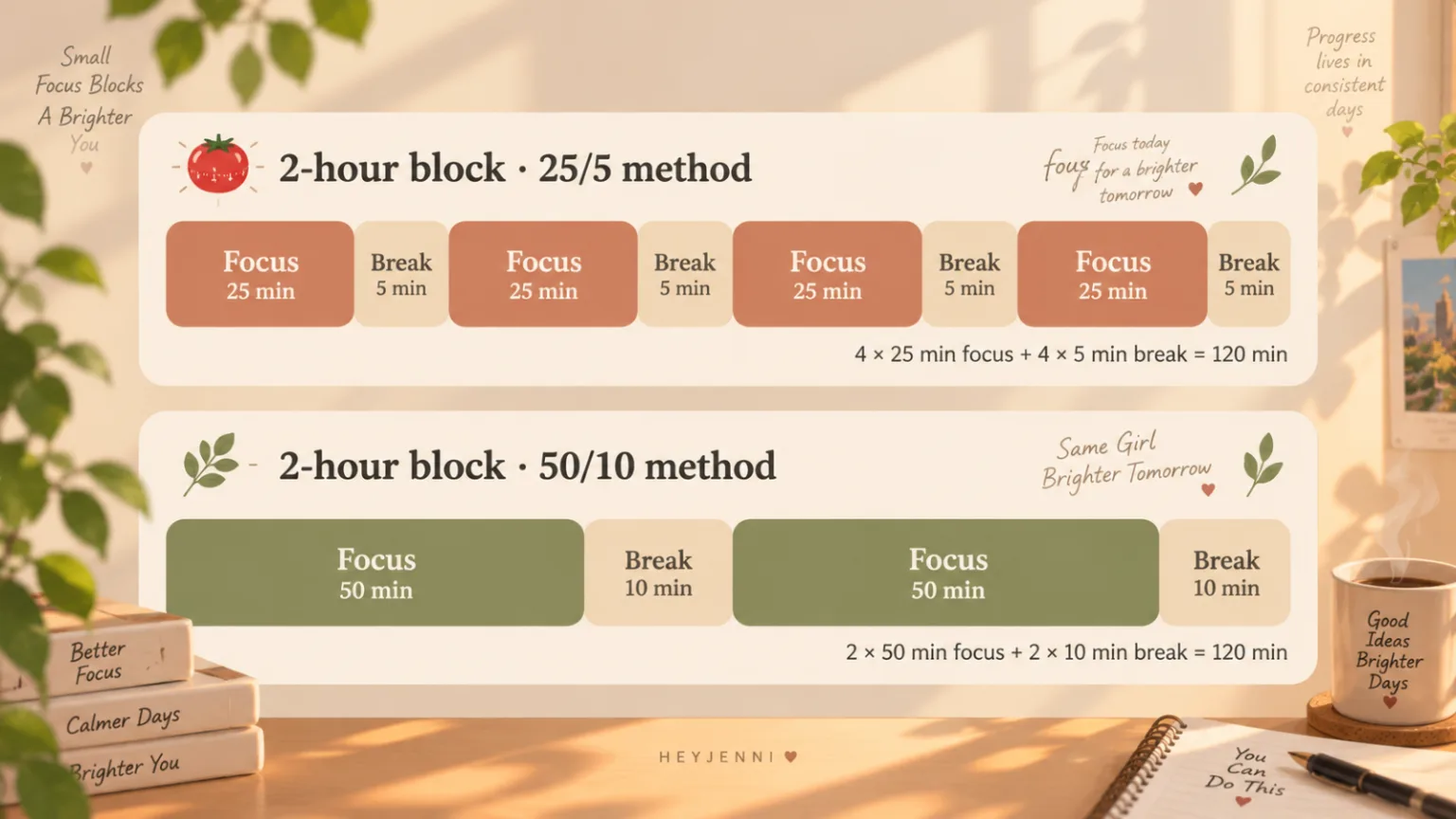
This is the original rhythm: twenty five minutes of focus, a five minute break, and a longer break after about four blocks.
It works because the commitment is small. Twenty five minutes is roughly one chapter, one problem set, one section of a draft. You can see the end from the beginning, so your brain stops negotiating and gets on with it.
| What it is good at | Where it gets annoying |
|---|---|
| Making it easy to start | Ending right when you found your rhythm |
| Days when your energy is low | Tasks that need a long setup, like debugging |
| Work that comes in small pieces | Breaks that interrupt a train of thought |
| Environments where you get interrupted | Days when five minutes is not enough to rest properly |
Twenty five minutes is also a friendly number for counting. Four blocks is a solid morning, and it is easy to see in the evening what the day actually held.
50 and 10: the deep work rhythm
Fifty minutes of focus with a ten minute break is the most popular longer variation, and it fits work that needs you to hold several things in your head at once.
The first ten minutes of any hard task are usually loading time. You are remembering where you left off, opening the right files, and rebuilding the picture. With a 25 minute block, a third of your session goes to that. With 50, the loading time is a smaller share and the rest is actual work.
| What it is good at | Where it gets annoying |
|---|---|
| Deep reading, writing and coding | Starting on a day when you already feel tired |
| Problem sets and long calculations | Environments with frequent interruptions |
| Fewer, longer breaks | Losing focus in the last ten minutes |
| Work where switching costs you a lot | Fitting sessions into short gaps in your schedule |
The trade is simple. Longer blocks give you more depth and ask for more energy.
Side by side
| 25 and 5 | 50 and 10 | |
|---|---|---|
| Easy to start | Very | Moderate |
| Time to reach deep focus | Can feel short | Plenty |
| Breaks in two hours | About four | About two |
| Best for | Many small topics, admin, low energy days | Writing, coding, problem sets, long reading |
| Watch out for | Breaking your flow too often | Fading attention near the end |
| Good in a noisy house | Yes | Harder |
Other intervals people use
52 and 17
A popular variation that comes from an analysis of time tracking data rather than from the original method. The idea is the same as 50 and 10, with a slightly longer rest. If 10 minutes never feels like enough, this is worth a try.
90 minute blocks
Some people prefer one long stretch in the morning for their hardest task, then shorter blocks for everything else. This works well for drafting, design and research, and poorly for anything that gets interrupted. In HeyJenni you can set this up in Custom mode.
15 and 5 for hard days
On days when even 25 minutes feels impossible, shrink the block instead of skipping the day. Fifteen minutes of honest work beats an afternoon of guilt, and it usually turns into more once you have started.
How to choose
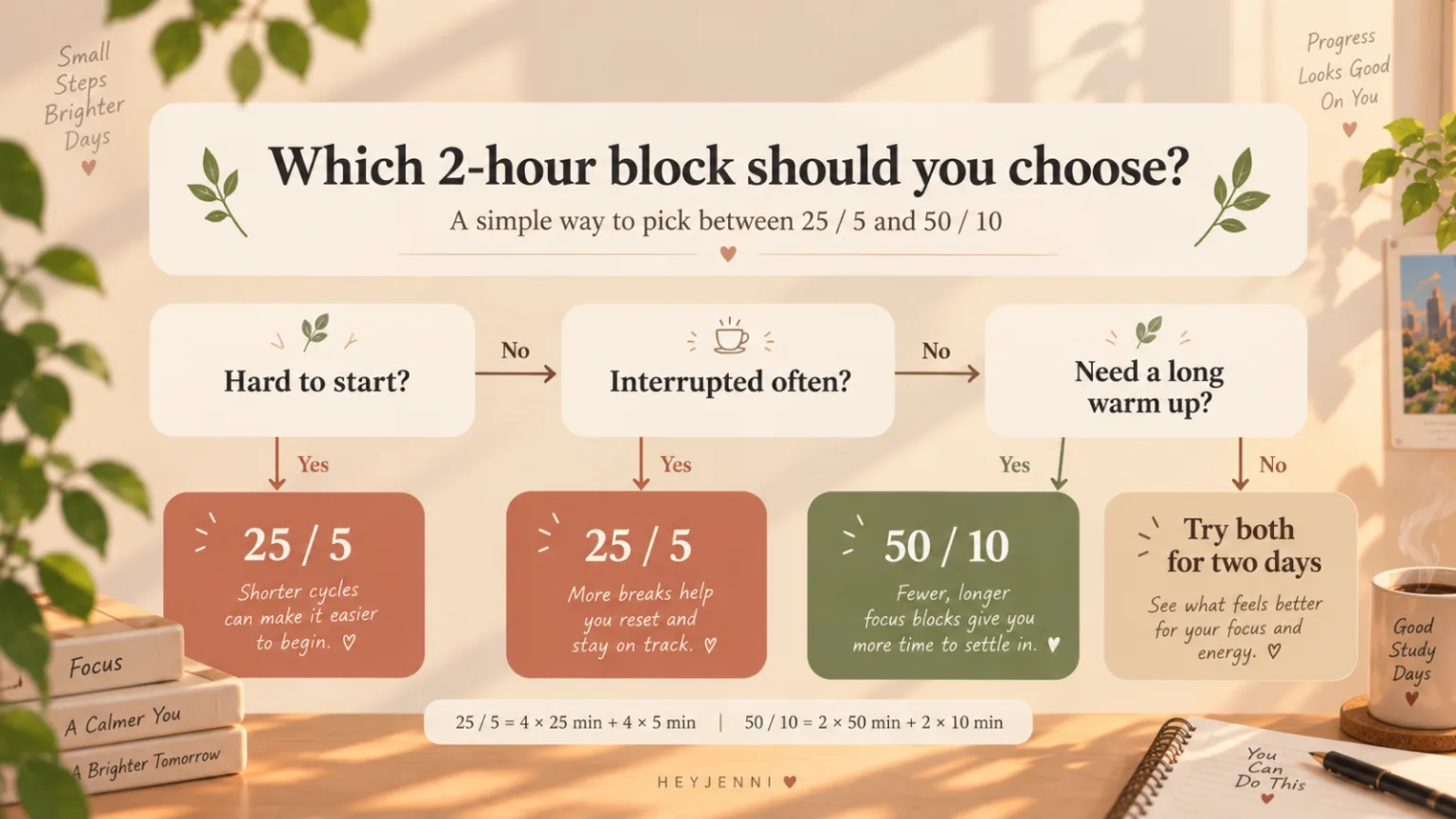
| If you... | Try |
|---|---|
| Struggle to start at all | 25 and 5, or even 15 and 5 |
| Get interrupted often | 25 and 5 |
| Need time to warm up before real focus | 50 and 10 |
| Work on one big task for hours | 50 and 10, or a custom 90 minute block |
| Feel tired after lunch | 25 and 5 for the afternoon |
| Keep ignoring the break alarm | A longer block with a fixed break |
| Study many small topics in one day | 25 and 5 |
| Write or code for a living | 50 and 10 |
You can mix them in one day. A common pattern is long blocks in the morning, when attention is freshest, and short blocks later for email, admin and review.
Try this one week experiment
Reading about intervals is slower than testing them. Give each one a couple of days and pay attention to two things only: how hard it was to start, and how you felt at the end.
| Days | Interval | What to notice |
|---|---|---|
| Monday and Tuesday | 25 and 5 | How easy was it to sit down? |
| Wednesday and Thursday | 50 and 10 | Did you reach real focus, and when? |
| Friday | Your own guess, in Custom mode | Did it feel natural or forced? |
| Weekend | Look back | Which days felt productive and calm, not just busy? |
The winner is usually obvious by Friday. If two of them feel equally good, keep both and use them for different kinds of work.
Signs your interval is not working
- You drift off around the same minute every session. If attention fades at minute 35 of a 50 minute block, your block is longer than your current stamina. Shorten it and grow it back over a few weeks.
- Your breaks keep stretching. A five minute break that turns into twenty usually means the block before it drained you. Try a shorter block with a slightly longer rest.
- You are annoyed every time the timer rings. That is the good problem. Move up to 50 and 10, or set a custom length in the middle.
- You never make it to the end. If most blocks get interrupted, the issue is your environment, not the number. Protect the time first: phone away, door closed, one honest message to whoever might need you.
- You are exhausted by mid afternoon. Too many long blocks in a row. Two deep sessions in the morning and shorter ones later beats four long ones and an empty evening.
The part that matters more than the number
Whatever you pick, two things do more for your focus than the exact minutes: one task per block, and a break you actually take. Get those right and both intervals work. Get them wrong and neither one will save the day.
If you are new to the method, the complete guide to the Pomodoro Technique covers the rest: handling interruptions, what to do on breaks, and the common mistakes that make people quit.
Frequently asked questions
Is 50/10 still the Pomodoro Technique?
It is a popular variation. The core idea is the same: one task, a fixed block of focus, and a planned break.
Which interval is best for studying?
It depends on the subject. Many small topics, flashcards and review work well in 25 minute blocks. Deep reading, essays and problem sets usually go better in 50.
Can I use different intervals in one day?
Yes, and most people end up doing exactly that. Long blocks for hard work, short ones for admin and email.
How long should the long break be?
Usually 15 to 30 minutes after three or four blocks. Leave your desk if you can.
What if I am in flow when the timer ends?
Finish the sentence or the thought, then take the break. Skipping rest feels efficient for about two hours and expensive for the rest of the day.
Is there a scientifically proven best interval?
No single number works for everyone. Task type, your energy and your environment all matter more than the exact minutes.