Body Doubling: Why Working Next to Someone Helps You Focus

You have probably noticed it without having a name for it. The dishes get done when a friend is over. The essay moves in the library but not at your desk. Nobody is helping you, nobody is watching, and yet the task somehow becomes possible. That effect has a name, body doubling, and you can set it up on purpose instead of waiting for it to happen.
 KirillView profile
6 min read
What is body doubling?
Body doubling is simple: you work on your task while someone else is nearby doing their own thing. That is the entire method. No accountability spreadsheet, no check ins, no reporting back.
The other person is not there to motivate you or to make sure you behave. They are just there. You might be on a video call in silence, sitting at the same table in a library, or in the same room while one of you studies and the other folds laundry.
The term comes from communities around attention difficulties, where it is a well known strategy, but the effect is not exclusive to anyone. Most people have felt some version of it.
Why it helps
There is no single tidy explanation, and anyone who gives you one is guessing. A few things seem to be doing the work.
- The task stops being optional. Alone, starting is a decision you can postpone forever. With someone there, the moment of starting is set by the situation rather than by your willpower.
- Leaving feels more awkward than staying. Nobody is judging you, but standing up to scroll your phone while another person is clearly working takes a small amount of effort. That tiny bit of friction is often enough.
- The task feels less heavy. Difficult work has a mood to it, and doing it alone at night in a quiet apartment makes that mood louder. Company changes how the same task feels, even when the work is identical.
- You borrow someone else's rhythm. When the person next to you settles in, you tend to settle in too. When they take a break, you notice you also need one.
Who uses it
Students, freelancers, remote workers, writers, people doing paperwork they have been avoiding for a month. It is popular with people who find it hard to get going on tasks that have no external deadline.
It is also widely discussed in communities around ADHD, where it is treated as a practical everyday strategy. If that is your reason for reading this, keep in mind that the internet is not a clinician and neither is this guide. Use it as one tool among others.
Ways to try it
| Format | Needs another person | Camera | Available anytime | Cost |
|---|---|---|---|---|
| Sitting with a friend or family member | Yes | No | Depends on them | Free |
| Library, cafe or coworking space | No, strangers work fine | No | Opening hours | Free to moderate |
| Video call with a friend, muted | Yes | Usually | Depends on them | Free |
| Paid coworking sessions with a stranger | Yes | Usually | Scheduled slots | Subscription |
| Study with me videos | No | No | Yes | Free |
| A focus room with a companion, like HeyJenni | No | No | Yes | Free, with a paid plan |
The formats at the top usually feel strongest, because a real person is really there. The formats at the bottom are weaker in that sense but available at eleven at night when nobody is around, which in practice is when most people need them.
How to make a session actually work
- 1Name the task out loud.
One sentence, before you start. "I am writing the introduction." Saying it turns a vague intention into something with edges.
- 2Agree on the time.
Fifty minutes, or twenty five if starting is hard today. Ending at a known time matters more than the length.
- 3Work in parallel, not together.
No commentary, no helping each other, no small talk in the middle. You are neighbors, not a team.
- 4Take the break together.
This is the part people skip, and it is where the company actually pays off. Two minutes of talking, then back.
- 5Say how it went at the end.
One line each. It closes the session and makes the next one easier to schedule.
When it does not work
- The other person wants to chat. A body double who narrates their day is not a body double. Agree on silence before you start, and it stops being awkward.
- You picked the wrong task. Body doubling is weak against tasks you have not defined. If you spend the session deciding what to do, the problem was the plan.
- You are exhausted. No amount of company fixes four hours of sleep. Rest is not a productivity failure.
- It stopped working after a while. Novelty fades. Change something: a different length, a different time of day, a different format.
Doing it with Jenni
HeyJenni is a small version of this idea. You open a room, Jenni is at her desk working on her own things, there is lofi playing, and you have a timer and a short list for today. During a focus session she stays quiet. On the break she asks how it went.
She is an AI, not a person, and it is worth being honest about what that means. There is no one on the other side who will notice if you quit. What you get is the setting: a place that looks and feels like working next to someone, available at any hour, with no scheduling and no camera.
For a lot of people that is enough to start, and starting is the part that matters.

Try it this week
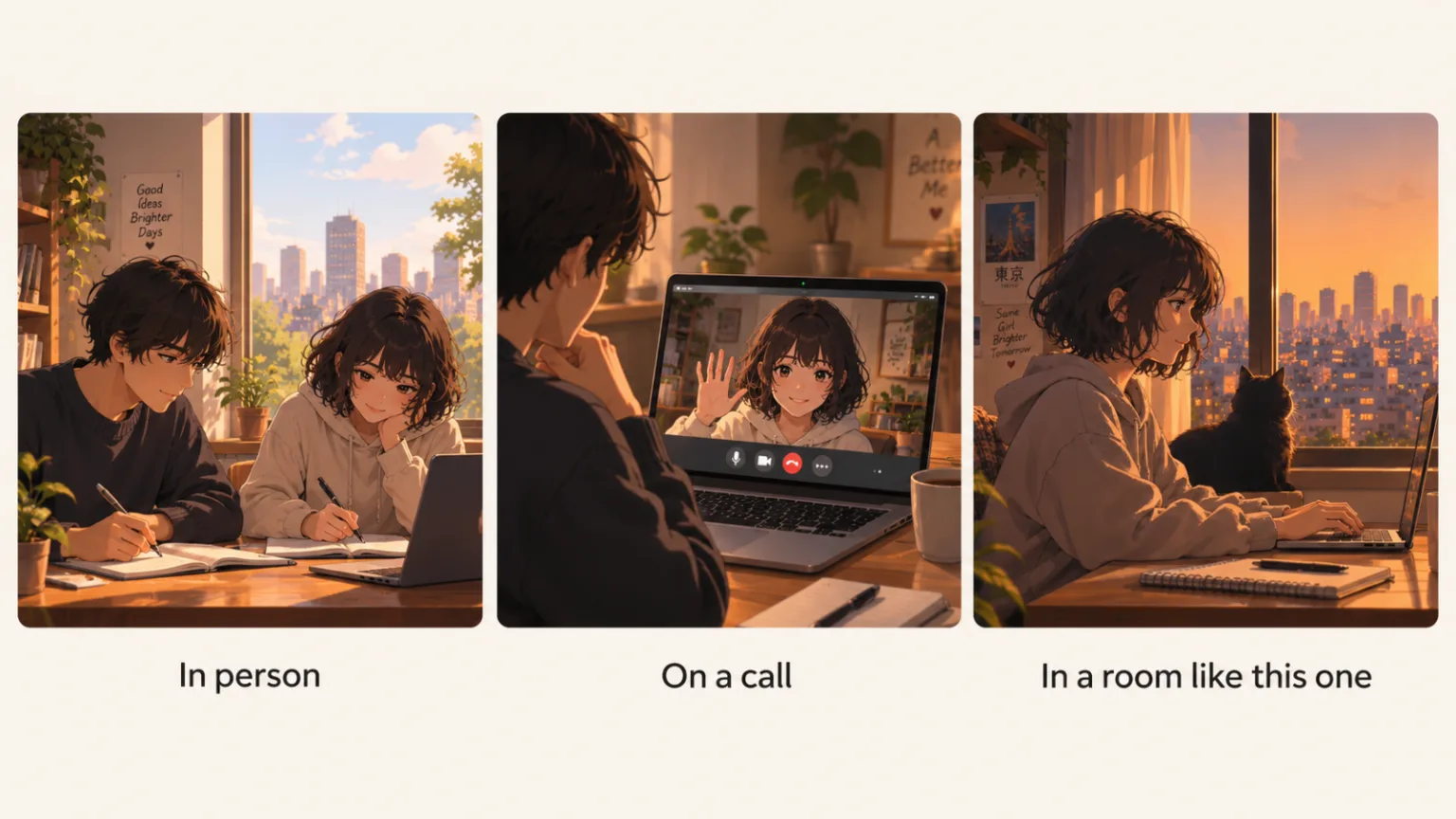
Pick one task you have been avoiding. Choose the easiest format available to you right now: a friend, a library, a call, or a room like this one. Set fifty minutes, say the task out loud, and start.
If it works, you will know within one session. If it does not, try a different format before deciding the method is not for you.
Frequently asked questions
Is body doubling only for people with ADHD?
No. It is widely discussed in ADHD communities, but plenty of people without any diagnosis use it to start tasks they keep putting off.
Does body doubling work online?
For many people, yes. Video calls, coworking sessions and study with me rooms all recreate parts of the effect. In person tends to feel strongest.
Do we have to talk to each other?
No, and usually it works better if you do not. Name your task at the start, work in silence, and talk during breaks.
Can an AI companion be a body double?
Partly. An AI cannot notice or care the way a person does, but the setting still helps many people start and keep going. Think of it as the easiest version to reach, not the strongest one.
Is it the same as coworking?
Coworking usually means sharing a space, sometimes with networking attached. Body doubling is narrower: someone present while you do a specific task.
How long should a session be?
Twenty five to fifty minutes works for most people. See our guide on choosing a focus interval for how to pick.