The Pomodoro Technique: A Complete Guide

You sat down two hours ago. You opened the right file, read the first paragraph, and then checked one message, looked something up, made a drink, and now the page looks exactly the way it did when you started. This happens to almost everyone, and it usually has nothing to do with laziness. A big task has no obvious edge to grab. The Pomodoro Technique fixes that with one simple trick: instead of starting a task, you start a timer.
 KirillView profile
9 min read · Updated
"Write the essay" or "study for the exam" can mean six hours of work, so your brain quietly looks for something smaller and easier instead. A timer gives that vague pile of work an edge you can grab, and everything below is about how to use it.
What is the Pomodoro Technique?
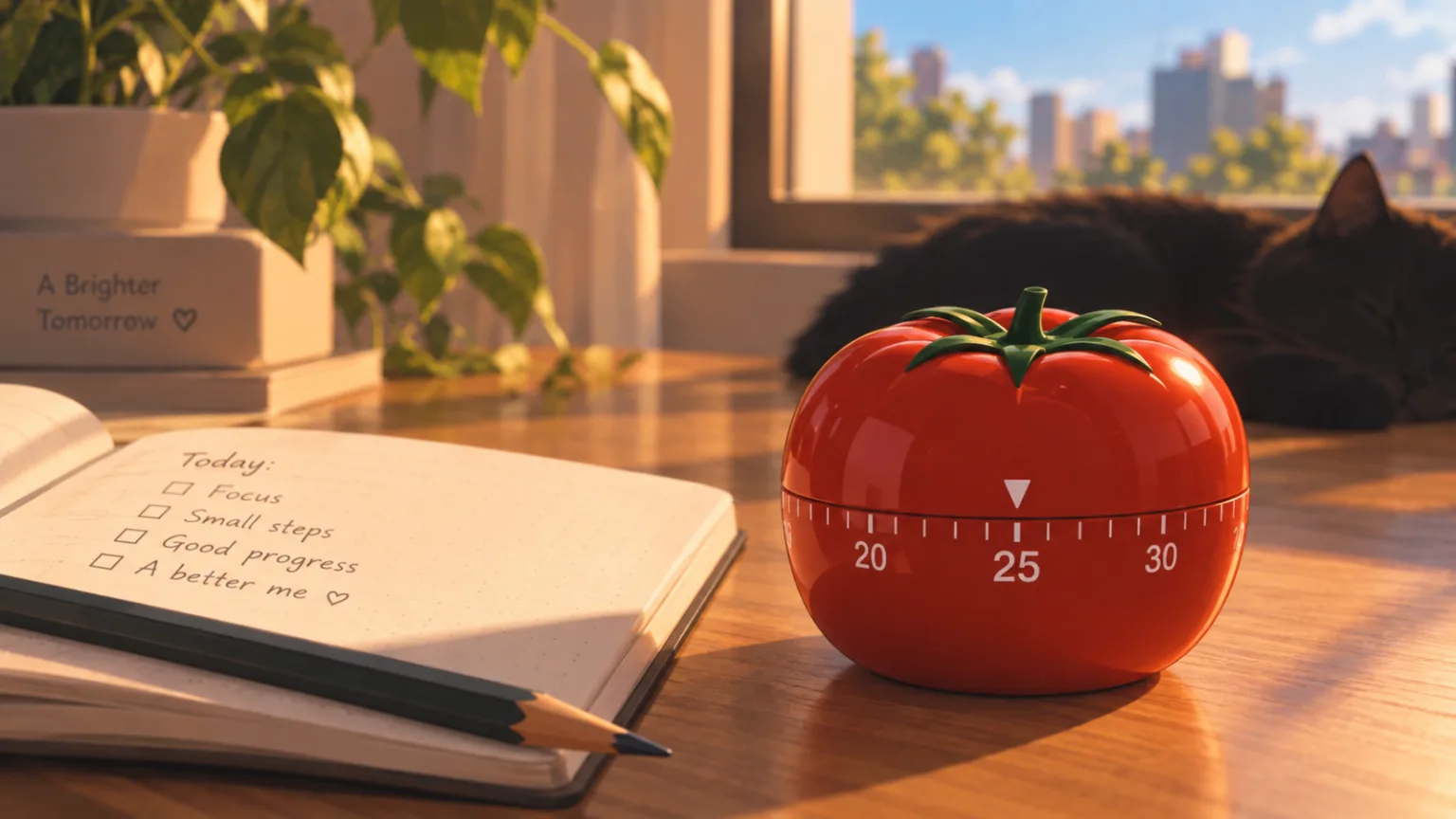
The Pomodoro Technique is a time management method that breaks work into short blocks of focused effort separated by planned breaks. One block is called a pomodoro, and it usually lasts 25 minutes. After each one you rest for about five minutes, and after roughly four blocks you take a longer break. It was created by Francesco Cirillo in the late 1980s, when he was a university student struggling to study. He promised himself he would focus for just ten minutes, and he used a kitchen timer shaped like a tomato to keep track. "Pomodoro" is Italian for tomato, and the name stuck. The method spread because it is easy to explain and costs nothing to try. You do not need an app, a system, a planner, or a morning routine. You need a task and a timer.
How the Pomodoro Technique works
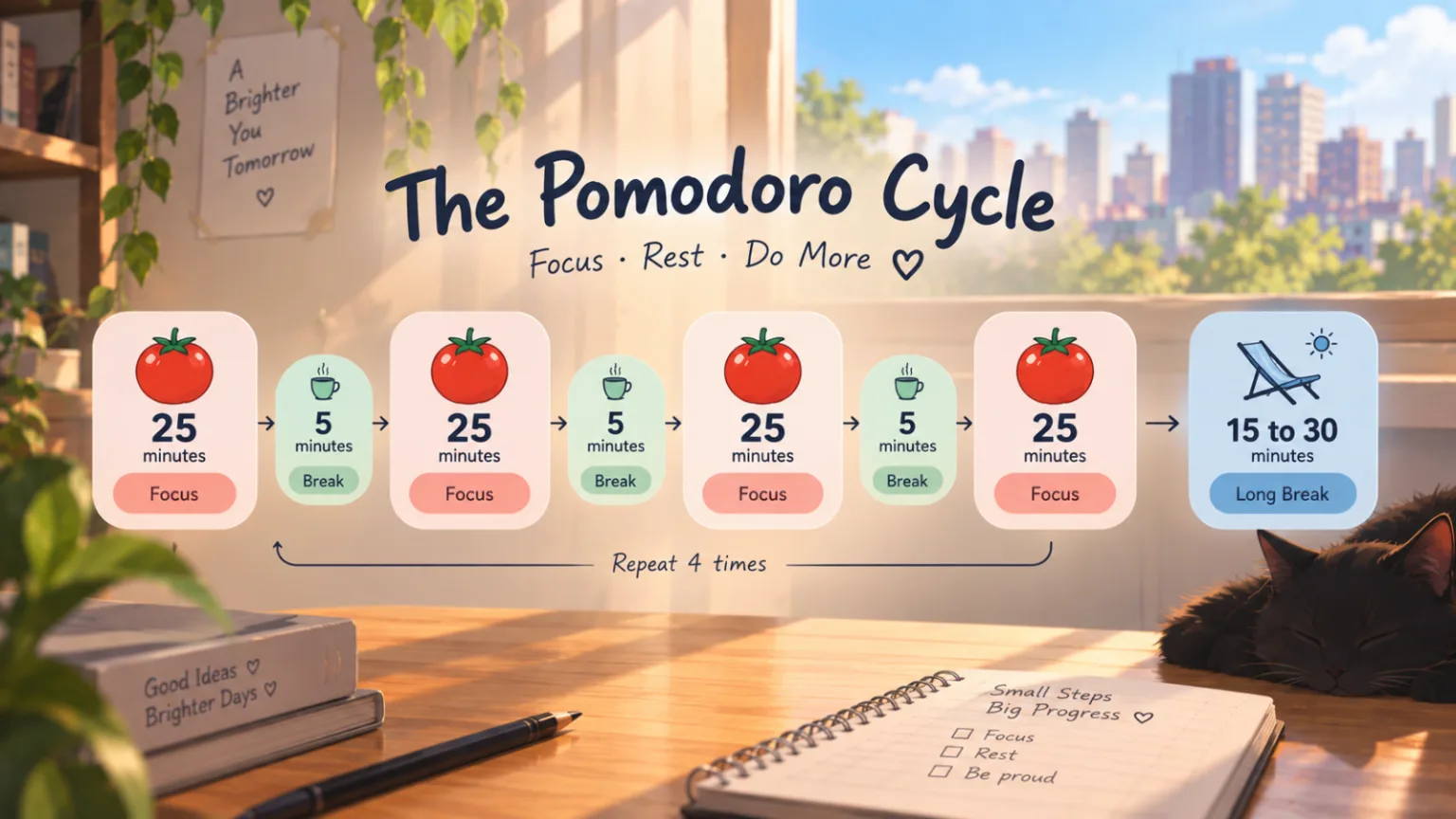
- 1Pick one task.
Not a project, one task. "Read chapter three" works. "Study biology" does not.
- 2Set a timer for 25 minutes.
Then start. The timer is the commitment, not the task.
- 3Work until the timer rings.
One task, no tab hopping. If a thought pulls at you, write it down and keep going.
- 4Take a five minute break.
Stand up, stretch, look out the window, drink some water.
- 5Repeat.
That was one pomodoro. Mark it down and start the next one.
- 6After three or four blocks, take a longer break.
Fifteen to thirty minutes, away from your screen.
Why it works
It makes starting smaller
Your brain resists a task it cannot see the end of. Twenty five minutes has an end you can picture from where you are sitting, and that is often enough to get you moving. The fun part is that starting is usually the whole battle. Once you are twelve minutes into a chapter, finishing it stops feeling like a decision.
It gives your attention a clear edge
Open ended work invites drift. When you know a break is coming at a fixed time, the message you wanted to check can wait, because waiting now has a deadline. You are not saying "never," you are saying "in eighteen minutes."
Breaks keep you steady
Working for four hours without stopping feels productive in the moment and expensive afterward. Short, planned rests keep your energy more even, so your fourth block of the day still looks like real work instead of staring at a screen and rereading the same line.
You start seeing where your time actually goes
After a week of counting pomodoros, you know things you only guessed at before. You know that a practice set takes you three blocks, not "an hour," and that you rarely get more than six good blocks in a day. Planning gets much less optimistic and much more accurate.
The rules worth keeping, and the ones you can bend
The original method has strict rules, and there is a reason for each of them. There is also a reason most people quietly adjust a few.
| Rule | Why it helps | You can bend it if |
|---|---|---|
| One task per pomodoro | Switching tasks drains focus | Several tiny tasks fit together, like replying to three emails |
| Do not split a pomodoro | A full block builds momentum | Something urgent comes up. Restart instead of pausing |
| Always take the short break | Rest keeps your focus steady | You are deep in a thought near the end. Finish it, then rest |
| Long break after four blocks | Prevents slow burnout | Three blocks feel like enough, or your blocks are 50 minutes |
| Always 25 minutes | Easy to start, easy to count | Your work needs longer stretches. Try 50 and 10 |
The one rule I would not bend early on is the break. Skipping breaks feels like dedication, and it works for about two hours. Then it stops working for the rest of the day.
What to do when something interrupts you
Interruptions are the reason most people give up on the method, so it is worth planning for them before they happen.
When the interruption comes from your own head
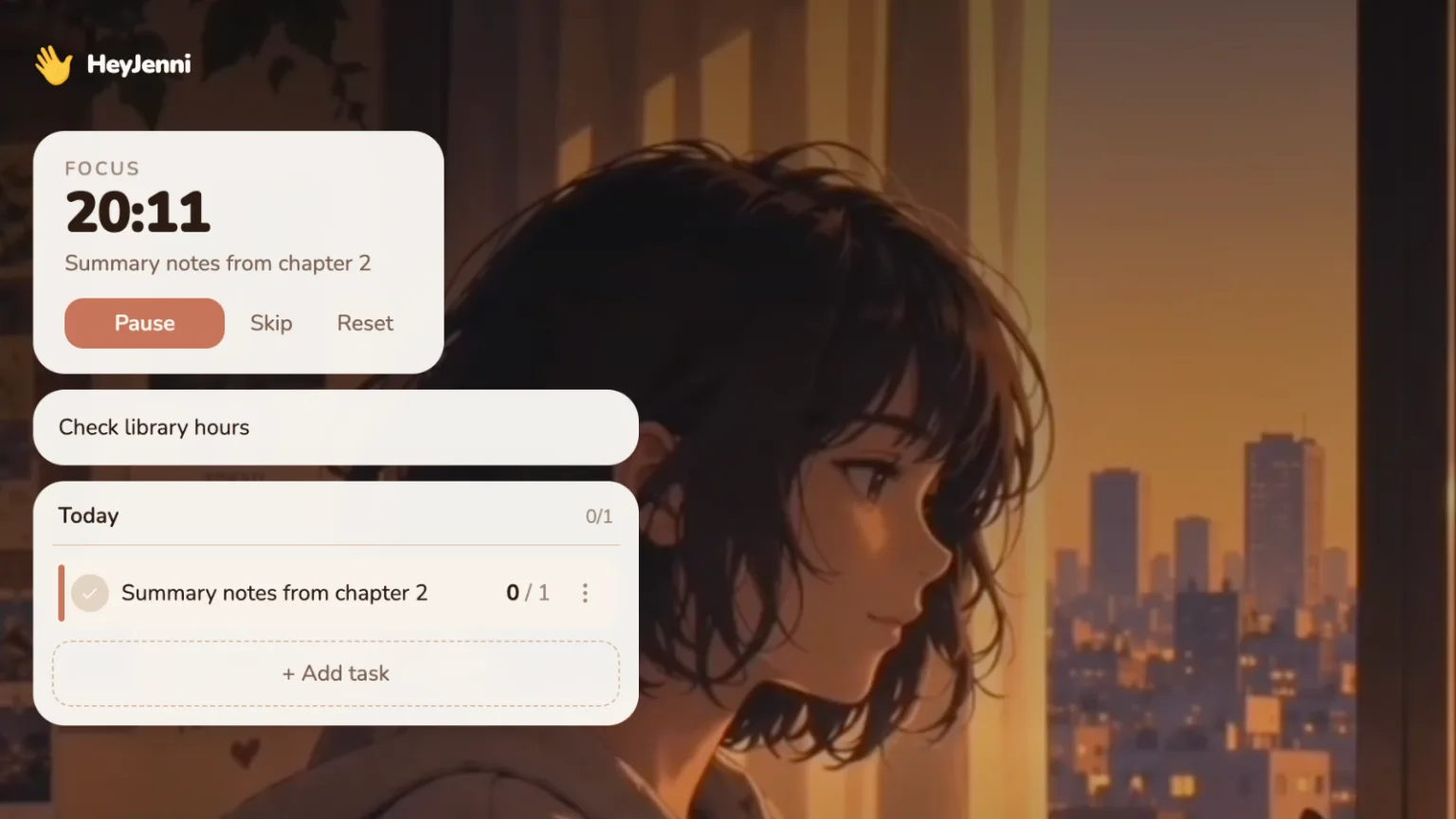
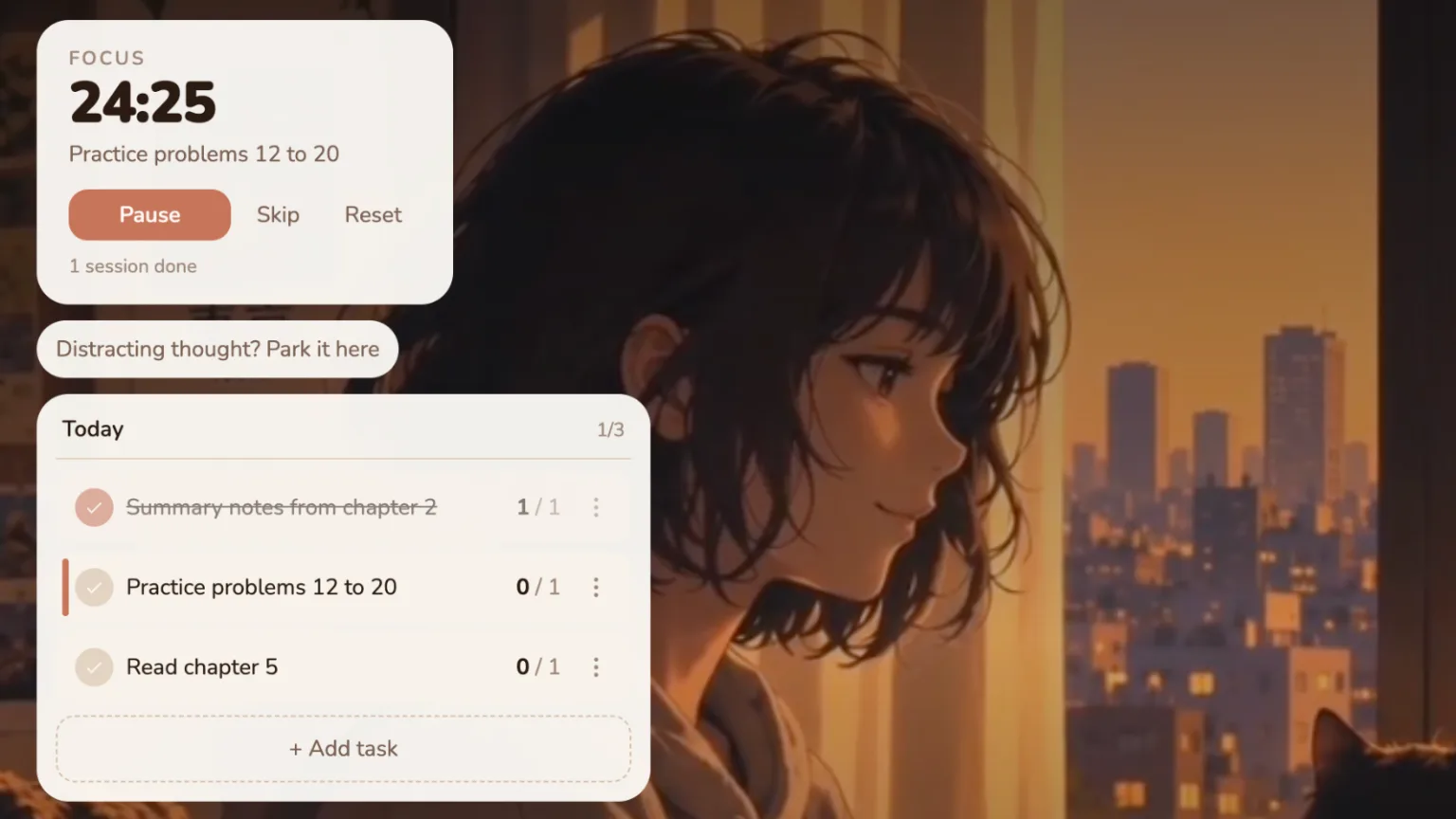
You will suddenly remember a package, a message, a fact you wanted to look up. This is normal, and it is not a sign that you are bad at focusing. Your brain is just clearing its desk. Write it down in one line and go back to work. That is it. The thought stops circling once it exists somewhere outside your head, and you can deal with all of them in your break. Half of them will turn out to be nothing. In HeyJenni this is built into the room. During a focus session you can park a thought in one line right under the timer, and it is waiting for you when the break starts.
When the interruption comes from another person
The classic approach is to protect the block without being rude. Tell the person you are in the middle of something, agree on when you will get back to them, and then actually do it. People are usually fine with "give me fifteen minutes," especially when you come back on time. The part that builds trust is the coming back.
When you really do have to stop
Sometimes the interruption wins. A call you have to take, a person at the door, a problem that cannot wait. In that case the block is over. Do not try to salvage nine minutes of it. Handle the thing, then start a fresh pomodoro when you are back.
How long should a pomodoro be?
Twenty five minutes is the classic answer, and it is a good place to start because it is short enough to feel easy. It is not the only option.
| Interval | Feels like | Good for |
|---|---|---|
| 25 and 5 | Quick and low pressure | Starting, admin, tired days, lots of small topics |
| 50 and 10 | Enough room to go deep | Writing, coding, problem sets, long reading |
| Custom | Your own rhythm | Work that does not fit either, like a 90 minute drafting block |
If you often find yourself annoyed when the timer rings because you were finally into it, that is a sign to try longer blocks. If you keep putting off starting, go shorter. Our guide on choosing a focus interval walks through both in detail.
What to do on your breaks
A break is supposed to give your attention somewhere else to go. Some activities do that, and some just swap one screen for another.
| Try this | Be careful with this |
|---|---|
| Stand up and walk around the room | Social media, which rarely stops at five minutes |
| Look out a window or at something far away | News, which pulls your mood into the next block |
| Get water, tea or coffee | "One quick email" that turns into three |
| Stretch your shoulders and neck | Starting a different task |
| Stare at nothing for a minute | A video that runs longer than your break |
You do not have to be virtuous about it. The test is simple: when the break ends, is it easy to go back? If it is, the break worked.
Five mistakes that make the method fail
- The task is still too big. "Write the report" is not a pomodoro. "Draft the intro" is. If you sit down and feel that heavy pause, your task probably needs one more level of detail.
- You skip breaks because you are on a roll. Tempting, and it costs you later in the day. Take the break, then ride the momentum into the next block.
- Your phone sits on the desk. Even face down, it takes attention. Put it in a drawer, in a bag, or in another room. Twenty five minutes is a short time to be unreachable.
- You make the rules too strict. People abandon the method after one broken block because they decided a day with an interrupted pomodoro is a failed day. It is not. You are keeping score of focused work, not of perfection.
- You start without a plan. If you decide what to work on at the beginning of each block, you spend the first five minutes deciding. Decide what you want to finish today, write it down, and only then start the timer.
Using the technique for different kinds of work
Studying
One block, one topic. Reading a chapter, working through twenty flashcards, doing five practice problems. For heavy material, try reading in one block and writing a short summary from memory in the next. That summary is where the actual learning tends to happen.
Writing
Outline in the first block, draft in the second and third, and edit later, ideally not on the same day. Writing and editing use different parts of your attention, and mixing them is why a first paragraph can eat an entire evening.
Coding
Twenty five minutes can feel short here, because loading a problem into your head takes time. A lot of developers use 50 and 10 instead. Use the break to step away from the screen rather than to scroll, and you will come back to bugs with fresher eyes.
Remote work
Give messages and email their own blocks instead of letting them leak into everything else. Two focused blocks for correspondence usually beat six hours of half watching an inbox.
Making it yours
The version of the method that works is the one you still use in three weeks. Keep the parts that help you start and rest, and drop the ceremony that does not. For most people that means: one thing you want to finish written down before the first timer, one task per block, a real break, and no guilt about a day that only had two good blocks in it. Two blocks of real focus beat five hours of half attention, and you will still have the evening.
Frequently asked questions
Is the Pomodoro Technique good for studying?
Yes, and it is popular with students for a reason. It turns a vague study session into a countable number of blocks, and the regular breaks make long study days much easier to survive.
What if 25 minutes is too short?
Try 50 minutes with a 10 minute break, or set your own length. The rhythm of focus and rest matters more than the exact numbers.
Can I listen to music during a pomodoro?
Many people do. Music without lyrics, like lofi, is a common choice because it fills the silence without competing for the part of your brain that handles words.
What counts as one pomodoro?
One complete focus block on one task, usually 25 minutes, without switching to something else. If it gets cut short, it does not count, and that is fine.
How many pomodoros should I do in a day?
It depends on your work and your energy. Four is a solid day for most people, and eight is a lot. Track your real number for a week before setting a target.
Do I need a special timer?
No. Any timer works, including the one on your phone, although the phone brings its own problems. A dedicated Pomodoro timer just saves you from resetting it and keeps count of your blocks.